Which brands make the best 14000 BTU portable air conditioners?
The best 14000 BTU portable air conditioner brands are ranked below:
- [shortcode-15034497818145158970034718269643464479420232254328] (Average overall score: [shortcode-01803576617726331352096695913483503819572251138130])
- [shortcode-02808756840974245907170123202220540592751616893383] (Average overall score: [shortcode-09950065238861953254136906156096502444531725856353])
- [shortcode-16454746821777821684175532144259672568620359578274] (Average overall score: [shortcode-14886883626413261621017195162112970567281741478140])
The chart below ranks 14000 BTU portable air conditioner brands by average overall score.
[horizontal-chart-17054129912805191803081940395828163593273724547094]
What room size can a 14000 BTU portable air conditioner cool?
A 14,000 BTU portable air conditioner can usually cool about 30–50 m² in a closed, reasonably insulated room; larger claims need favorable conditions. Sun exposure, open doorways, high ceilings, and cooking or computer heat can reduce the area a single portable unit handles comfortably.
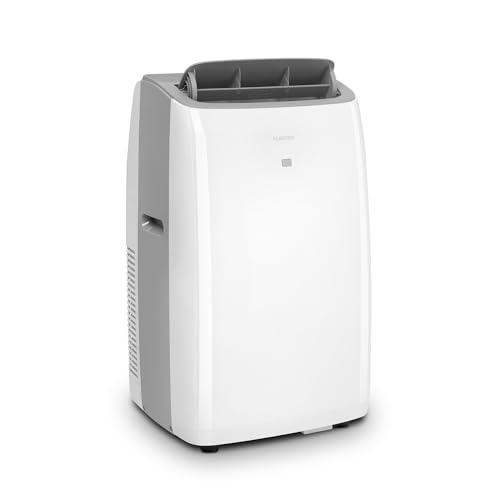
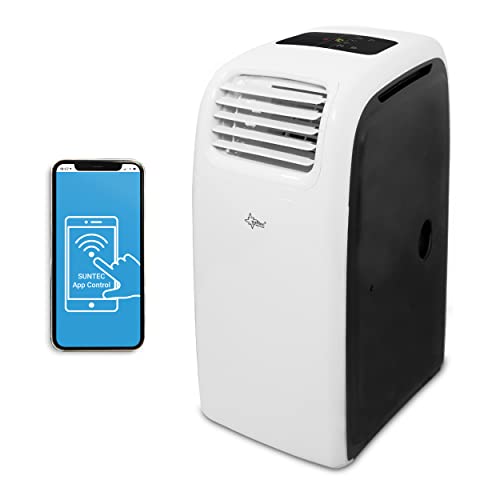
Use the lower end for a sunny bedroom or living room with leaks, and treat claims above 50 m² as optimistic unless the room is well sealed. The Suntec 17216 and Klarstein Grandbreeze Pro publish especially large room figures, but a high maximum-room number does not replace a delivered-capacity check.
For rooms below about 20 m², a 14,000 BTU unit may cycle too aggressively and feel drafty or damp if the thermostat is poorly tuned. Match the actual heat load and the DOE/SACC rating, not just the nominal label.
The chart below shows the maximum-room-size distribution of 14000 BTU portable air conditioners.
[vertical-chart-04952692606069303385163096073429702157173140360009]
How do ASHRAE and DOE/SACC ratings affect a 14000 BTU model?
ASHRAE BTU/h is a nominal laboratory capacity, while DOE/SACC is a more realistic seasonal rating that accounts for heat entering through the exhaust hose and other operating losses. A portable air conditioner advertised as 14,000 BTU under ASHRAE can therefore have a noticeably lower SACC figure.
Use DOE/SACC to compare how much cooling reaches the room, then check the test conditions and hose setup. The label is still useful for identifying the product tier, but it should not be treated as a direct promise that every 14,000 BTU model cools equally.
Is 14000 BTU too powerful for a small room?
A 14,000 BTU portable air conditioner can be too powerful for a small room, especially below roughly 15–20 m². Rapid cycling may lower comfort without removing enough moisture, and the large cabinet, hose, and fan can be disproportionate to the space.
If the room is closer to 20–30 m² and has strong sun or poor insulation, the extra capacity can be useful when the thermostat modulates smoothly. In a well-insulated room with little internal heat, however, the same capacity may reach its set point too quickly and leave humidity behind.
Use a dehumidify or low-fan mode where available, keep the door closed, and choose a smaller unit when the heat load is modest.
How much electricity does a 14000 BTU portable air conditioner use?
Most 14,000 BTU portable air conditioners draw roughly 1.2–1.6 kW while the compressor is running, based on published input figures. A unit drawing 1.3 kW uses about 1.3 kWh per hour at full load; at an illustrative tariff of 30 pence per kWh, that is about 39 pence per hour before cycling is considered.
Real consumption is lower when the compressor cycles off, but high outdoor temperatures, poor seals, and a long hose keep it running longer. Compare input power with DOE/SACC capacity, use a timer, and seal the window carefully because a lower wattage number is not useful if the unit delivers less cooling.
How noisy are 14000 BTU portable air conditioners?
Most 14,000 BTU portable air conditioners fall around 52–65 dB at their published maximum, so they are audible in a quiet bedroom. The quieter examples sit near the low-to-mid 50s, while several larger or less refined cabinets reach 64–65 dB; test modes are not identical.
Noise comes from the compressor, fan, vibration, and hose contact as well as the cabinet rating. Put the unit on a solid level floor, isolate ducts from walls, and use night or low mode after pull-down. Compare the same measurement mode and remember that a dual-hose setup can sound different once adapters are fitted.
The chart below shows the maximum-noise distribution of 14,000 BTU portable air conditioners.
[vertical-chart-09002329930660314177005258514706278066192659731273]
Is a single-hose or dual-hose design better at 14000 BTU?
At 14,000 BTU, a dual-hose design is usually better for a hot, leaky room because it brings condenser air from outside instead of depressurising the room. A single-hose model is easier to install and can be sufficient in a small, closed room, but it may pull replacement air through gaps.
Dual hose only wins when both ducts fit the window kit, stay short, and remain sealed; the second hose also adds bulk and installation work. Compare DOE/SACC output, input power, noise, and cabinet weight rather than assuming the hose count alone determines efficiency.
If the unit will be moved often or stored after each use, a well-sealed single-hose model can be the more practical choice. For fixed summer installation in a difficult room, the dual-hose airflow path is generally worth prioritising.
How much do 14000 BTU portable air conditioners cost?
Prices for 14,000 BTU portable air conditioners span roughly £300-£950, but the best-equipped everyday models generally start around £430. Entry-level units near £300-£390 usually trade away inverter control, quieter operation, or app features; they can still suit occasional cooling when the room is well sealed.
Around £400-£600, expect better controls, more consistent room coverage, and useful extras such as heating, Wi-Fi, or dual-hose/inverter designs on selected models. Premium options above £600 should justify the price with lower noise, stronger efficiency, or a better service and installation package rather than a larger BTU label alone.
The chart below shows the price distribution of 14,000 BTU portable air conditioners.
[vertical-chart-12537952908994697972173965772566784580484194631059]